
Is your die fair?
Log the rolls of a real die — by tapping or just saying the numbers out loud — and Dice Lab turns them into a proper statistical report that explains itself in plain language.
Android APK · free · no accounts, no ads, no analytics
What it does
A statistician in your dice bag
Every number comes with the reasoning behind it. Nothing is claimed that the data cannot support.
Say the numbers
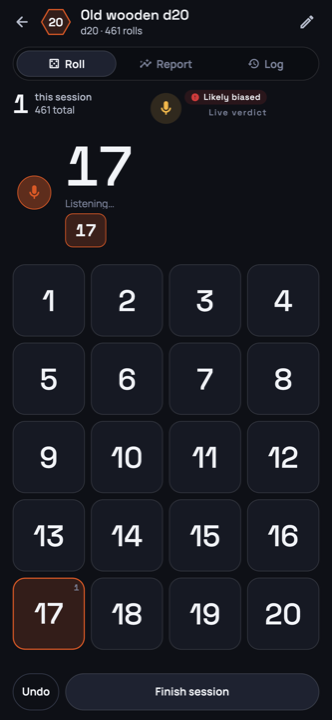
Turn on voice input and just speak the results — the model runs on the device, so after a one-time download nothing needs the network. Russian and English.
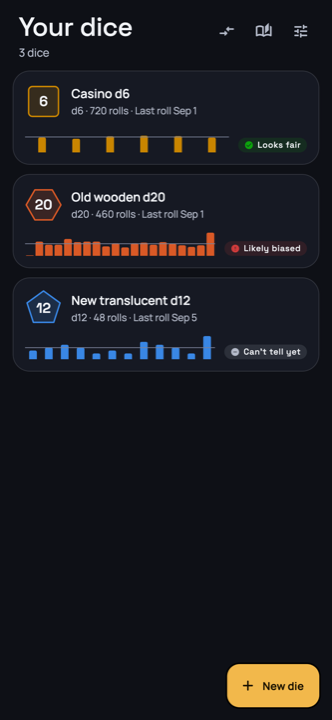
A verdict, not a p-value
A Bayes factor can speak in favour of fairness, not only against it — and it grows honestly as rolls accumulate instead of jumping on a lucky streak.
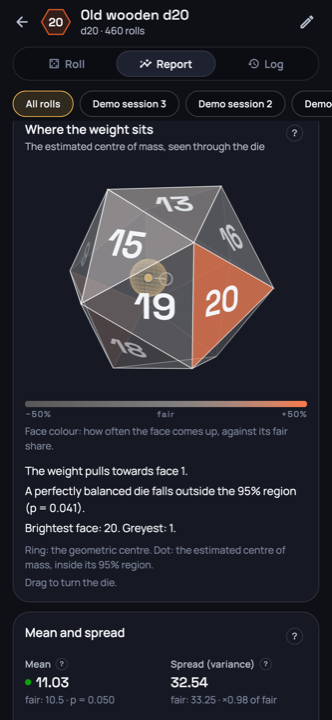
See where the weight sits
Turn a translucent 3D die with your finger. Faces that come up more often glow; the cloud inside is where the centre of mass really is, with 95% credibility.
Fourteen kinds of evidence
Per-face intervals, streak probabilities, correlation between consecutive rolls, entropy, transition maps — and the physics of a squashed or lopsided die.
Duel two dice
Which one wins head to head, on which faces they differ, which rolls higher on average, and how many more rolls would settle it.
Spinners too
Wheels and spinning tops get the same treatment, seen from above: sectors coloured by frequency and the same centre-of-mass cloud.
Hands free
Roll, say the number, keep rolling
Recognition is streaming and fully on-device. The number appears large on screen as you say it, so you never look away from the table for long.
- Nothing leaves the phone. Audio is processed in memory and discarded.
- Impossible values are caught. Say twenty-three on a d20 and it is shown struck through, not recorded.
- Say “undo” to drop the last roll, or delete any roll from the strip with two taps.
Physics
Real dice fail in two ways
A die slightly short along one axis rests on that pair more often. A die with an off-centre mass lands heavy side down, so the opposite face shows. Both are invisible in a list of counts and obvious once the faces are paired up.
Under the hood
Built like an instrument
The statistics live in a separate pure-Dart package, checked against closed-form values, brute-force enumeration and published reference numbers.
Find out about your dice
Free and open source. Install the APK from GitHub, or build it yourself from the repository.
Android 7.0+ · iOS build available from source